The Real Cost of Manual NDIS Rostering for Providers
Most NDIS providers know that their rostering process is more painful than it needs to be. What they often underestimate is how much that pain costs the organisation beyond the hours spent building spreadsheets every fortnight.
Rostering Is Not Just a Scheduling Problem
When you build rosters manually, whether in spreadsheets, whiteboards, or basic calendar tools, you create a chain of operational risks that extends well beyond who works which shift. Rostering errors affect payroll accuracy, participant service continuity, SCHADS Award compliance, and the ability to demonstrate to auditors that shifts were appropriately staffed.
An incorrectly classified shift type, for example, can mean the difference between an AM Shift rate and a PM Shift rate under the SCHADS Award. Do that across dozens of shifts per fortnight and the exposure adds up quickly, either as an underpayment liability or an overpayment that quietly erodes your margins.
The Contracted Hours Problem Most Providers Ignore
Every permanent staff member has contracted hours per fortnight. When manual rostering is in place, tracking whether individual staff members are approaching or exceeding those contracted hours requires someone to actively calculate this each time a shift is added. In practice, it rarely happens with the rigour it deserves.
The result is either support workers consistently over-hours and at risk of burnout, or a messy conversation when a staff member realises they have been rostered beyond what their contract reflects.
Contracted Hours Violations Are One of the Most Common SCHADS Award Compliance Risks in the Sector
A structured rostering system surfaces these breaches in real time, before the fortnight is locked in.
What Happens When Cover Falls Through
Every provider has experienced it. A support worker calls in sick the morning of a shift, and the coordinator spends the next two hours making phone calls, hoping someone is available. By the time cover is arranged, the process has consumed staff time, created stress, and sometimes left a participant without support at the start of their day.
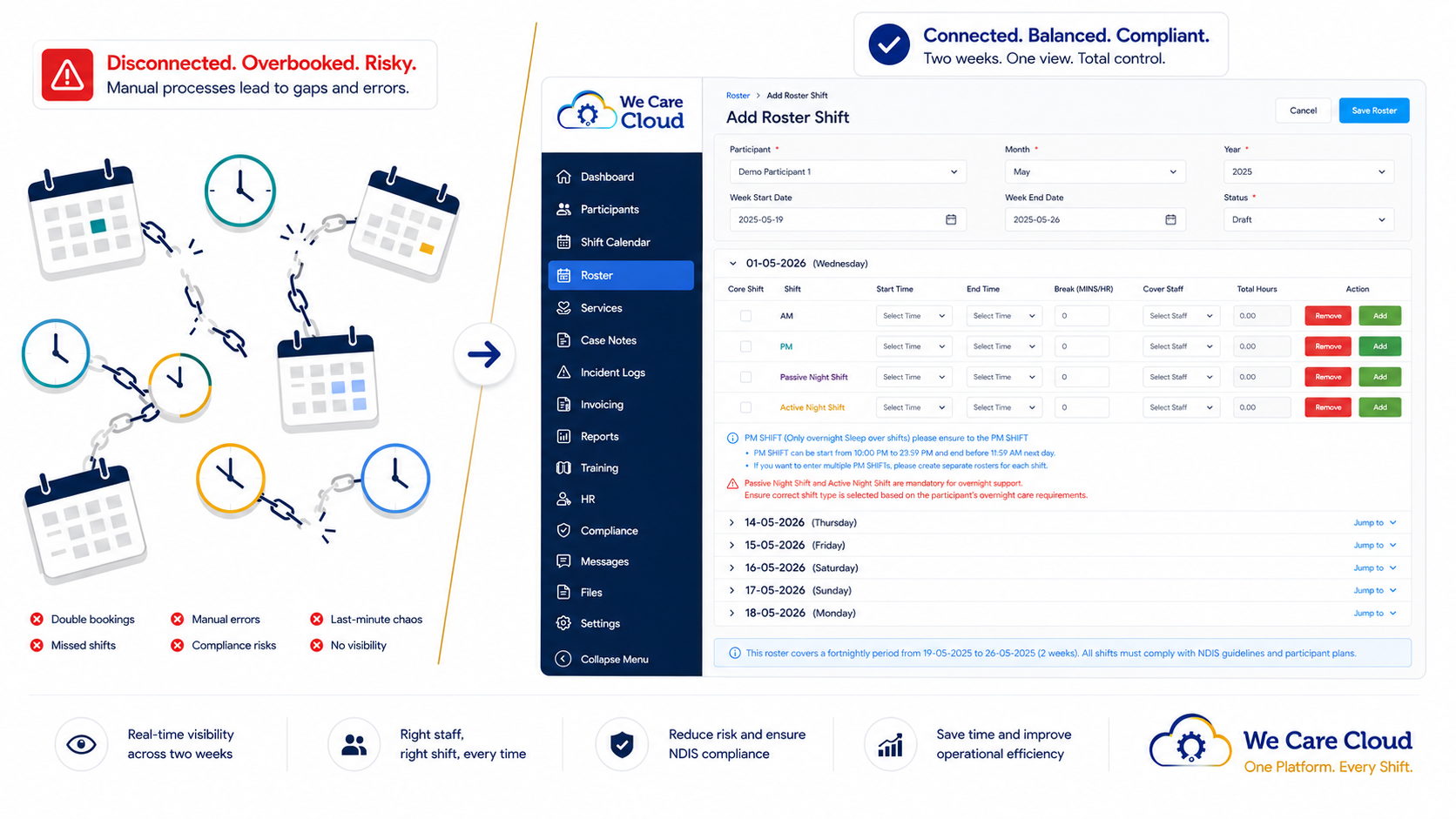
We Care Cloud's rostering module supports three layers of shift coverage. A primary staff member is rostered to a shift. A cover staff member is assigned as a backup in the same slot. If neither is available, an open shift can be broadcast to a selected group of staff, who receive email and dashboard notifications and can accept or reject via the platform. The shift manager reviews all responses through the Pending Shift Requests view and approves the successful applicant.
Notifications That Reach the Right People
One of the low-visibility costs of manual rostering is the time spent communicating shift allocations to staff. When a roster is finalised in a spreadsheet, telling support workers what they are working requires a separate step. When a roster is finalised in We Care Cloud, the platform automatically sends email notifications to all allocated staff. If changes are made, notifications can be re-sent. If a shift is cancelled, the affected staff member is notified.
The Copy and Repeat Problem
Most NDIS providers run similar rosters from one fortnight to the next. In a spreadsheet, this means copying and adjusting the previous fortnight manually, which introduces errors every time something is missed or pasted incorrectly.
WCC's roster module includes a copy function that replicates any individual shift configuration to multiple dates in a single action. It also supports copying an entire fortnight roster to a new period. Changes to the copied roster are made selectively rather than recreating the whole structure from scratch each time.
Rostering as a Compliance Record
When an NDIS audit reviews participant service delivery, the roster is one of the primary reference points. Auditors want to see who was rostered to each shift, whether shifts ran as planned, and whether the staffing configuration was appropriate for the participant's assessed support needs.
A spreadsheet cannot provide this level of traceability. A structured rostering system, with allocation IDs, finalisation timestamps, change history, and exportable PDFs, can. That difference is not just operational. It is a registration risk management decision.
Explore how We Care Cloud manages fortnightly rostering, cover staff, open shifts, and automated notifications for NDIS providers.
Explore the Roster Builder