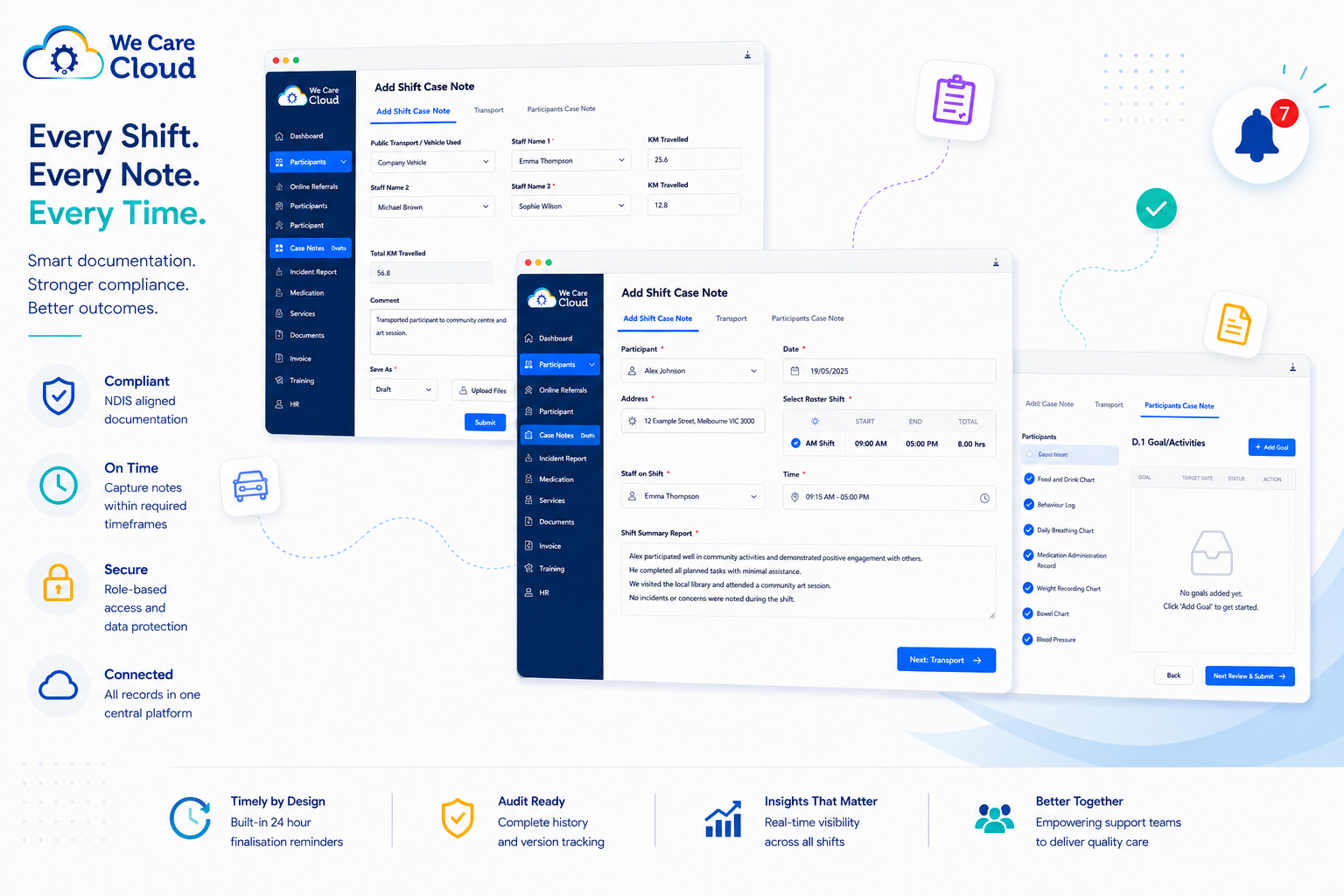
How Shift Case Notes Protect Your NDIS Registration
Shift case notes are easy to treat as an administrative afterthought. The shift is done, the participant is fine, and there is always something more urgent waiting. But when the NDIS Quality and Safeguards Commission comes knocking, your case note records become the primary evidence of how care was actually delivered.
What the Commission Is Actually Looking For
NDIS auditors assess whether the care documented matches the care planned in each participant's NDIS plan and service agreement. They review whether support workers completed shift records consistently, whether records were finalised promptly, and whether any gaps in documentation align with gaps in service delivery.
An incomplete or missing case note is not automatically evidence of poor care. But it creates a gap that an auditor must treat as unverifiable. Enough gaps, and the picture becomes difficult to defend regardless of how well your team actually performed on the floor.
The Gap Between Submitted and Finalised
One of the most common compliance vulnerabilities in NDIS organisations is the difference between a case note that exists and a case note that is complete. A draft case note sitting in the system for several days does not constitute a verified record. It is incomplete, potentially inaccurate, and not suitable for audit review.
The standard your organisation should be working toward is simple: every shift produces a finalised case note within a reasonable period after that shift ends. When that standard slips, even briefly, you accumulate a backlog of exposure that can take weeks to address.
Every Unfinalised Case Note Is an Open Compliance Risk
Draft records cannot be submitted as evidence during an NDIS Quality and Safeguards Commission audit. Only finalised records count.
How Automated Enforcement Changes the Dynamic
Most providers rely on coordination staff to manually follow up missing documentation. This works when the organisation is small. It stops working the moment you have more than a handful of support workers delivering shifts across multiple participants on multiple days.
We Care Cloud builds enforcement directly into the platform. When a shift case note has not been submitted three hours after the roster end time, the system automatically sends an email reminder to the support worker. If the record remains missing at the 24-hour mark, the system disables that staff member's login until the case note is submitted and finalised.
For draft records that have not been finalised, reminders go out at 48 hours and again at 72 hours, at which point login access is disabled again. Login is restored the moment the record is finalised. The process is automatic. No coordinator needs to chase anyone manually.
What the Wizard Captures and Why It Matters
Beyond the basic shift summary, the WCC case notes wizard prompts staff to record participant-specific data across up to eleven structured sections. These include goal progress, food and fluid intake, behaviour logs, medication administration records, blood glucose readings, bowel charts, and weight recordings.
Not every section applies to every participant. The platform flags which sections are mandatory for each individual based on their care configuration. Red exclamation markers identify required fields. The result is a structured, dated, participant-specific record that demonstrates the depth and consistency of support delivered.
Who Is Exempt and When Exemptions Apply
For participants where automated checks are not appropriate, the "Skip Shift Case Note Checks" flag in the participant profile disables enforcement entirely for all shifts linked to that participant. For individual staff members where exemption is warranted, the "Bypass Shift Case Note" flag in the user profile achieves the same outcome.
These controls exist to give organisations flexibility without compromising the default standard. Exemptions should be applied deliberately, documented in your internal governance records, and reviewed regularly.
Documentation Gaps Create Registration Risks
NDIS registration renewal and mid-term audits assess documentation practices as a direct indicator of governance quality. Providers who cannot demonstrate a consistent pattern of completed, timely case notes face a harder conversation with auditors and a more complex remediation process if issues are found.
The organisations that perform best in audits are not necessarily the ones doing the most extraordinary work. They are the ones who can show, clearly and completely, that ordinary care was delivered every shift, every day, without gaps.
See how We Care Cloud manages shift case note compliance automatically, from enforcement reminders through to audit-ready records.
See How Case Notes Work